Healthcare organizations have invested heavily in digitization, yet many clinical and operational workflows continue to function in silos. Hospital Information Management Systems (HIMS) manage inpatient operations, while Remote Patient Monitoring (RPM) platforms often operate as parallel environments for post-discharge care. The result is fragmented information, repeated administrative effort, and limited continuity across the patient journey.
The economics of unified healthcare extends beyond technology adoption. It is fundamentally about reducing information latency, eliminating redundant workflows, and enabling clinical teams to make decisions using a single, continuously updated view of the patient. When hospitals integrate operational systems with real-time patient monitoring, they create an environment where information moves seamlessly across departments, clinicians, and patients without requiring manual reconciliation at every stage.
Fragmented Patient Information Carries a Hidden Operational Cost
Most hospitals have access to significant volumes of patient data. The challenge lies in how that information is distributed across multiple systems and workflows.
Appointment details may exist in one application; consultation notes in another, laboratory results in a separate repository, and post-discharge patient data within an independent monitoring platform. Clinical teams spend valuable time locating information, validating records, and piecing together patient history before making decisions.
These administrative transactions create operational inefficiencies that extend across the hospital.
Delayed access to complete patient information can slow diagnosis, treatment planning, multidisciplinary coordination, and discharge decisions. Research on hospital length of stay consistently identifies delays in diagnostics and discharge planning as contributors to prolonged admissions, increasing resource utilization and operational costs while exposing patients to additional complications.
The same challenge continues after discharge. Traditional follow-up models rely on scheduled appointments or patient-initiated communication, leaving extended periods where changes in patient condition may remain outside the hospital’s visibility. Clinical deterioration identified late often requires greater intervention than issues addressed earlier through continuous monitoring and structured follow-up.
The cost of fragmented information therefore appears in multiple forms: duplicated documentation, disconnected workflows, delayed escalation, extended hospital stays, and avoidable administrative effort.
Unified HIMS and RPM Transform Workflow Economics
Many healthcare organizations operate both HIMS and RPM solutions yet continue to manage them as separate systems. Clinical teams document information within hospital workflows while remote monitoring data follows an independent path, requiring manual review, reconciliation, or re-entry into patient records.
The operational advantage of unified healthcare comes from eliminating these parallel processes.
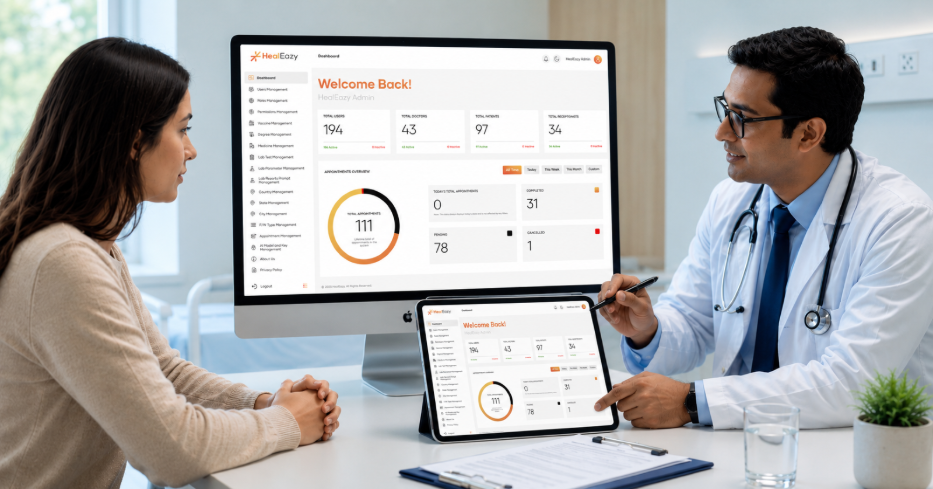
Within a unified healthcare platform, hospital administrators can manage appointments, consulting centers, departments, medicines, vaccines, laboratory tests, users, and system activity through a centralized operational view. Doctors simultaneously access consultation-ready patient profiles, structured electronic medical records, longitudinal patient trends, and real-time clinical flags, while patients maintain connected medical profiles, synchronized vital signs, appointments, and follow-up information within the same ecosystem.
This unified architecture changes the nature of administrative work.
Instead of transferring information between systems, staff members work with synchronized data that remains accessible across operational and clinical functions. Patient histories, vital signs, laboratory reports, appointments, and ongoing recovery information remain connected throughout the care journey, reducing repetitive data handling and minimizing workflow interruptions.
The value therefore comes from workflow consolidation rather than additional data collection.
Real-Time Data Enables Dynamic Resource Allocation
Hospital operations depend on continuous prioritization of people, departments, and clinical resources. Static reports and delayed information limit the ability to respond effectively to changing patient needs.
Real-time data integration introduces a more dynamic operating model.
Research supports the use of real-time information and predictive analytics to improve forecasting for admissions, staffing requirements, equipment utilization, and overall resource allocation. Operational decisions can be based on current clinical activity instead of retrospective reporting, allowing hospitals to coordinate services with greater precision.
The same principle applies at the patient level.
A unified healthcare platform provides live patient vitals with automatic flags for abnormal values while presenting longitudinal trends across custom time ranges. Rather than reviewing isolated observations, clinicians can evaluate patient progression using continuously synchronized information.
Remote patient monitoring further extends operational visibility beyond hospital walls. Connected health devices automatically synchronize vital signs, while patients continue tracking nutrition, activity, sleep, stress indicators, appointments, and laboratory reports within a single environment.
This continuity supports an exception-based care model.
Clinical attention can focus on flagged changes and relevant trends instead of routine manual status checks across every discharged patient. Administrative effort shifts toward coordinated intervention rather than repetitive information gathering, allowing hospitals to use clinical resources more efficiently.
Connected Workflows Strengthen Care Continuity Across Admission and Recovery
Length of stay and readmissions remain closely linked to the quality of care coordination rather than individual clinical events alone.
Discharge planning requires complete patient information, multidisciplinary collaboration, and structured follow-up processes. When inpatient records and post-discharge monitoring exist in separate workflows, continuity depends heavily on manual communication between teams and scheduled patient interactions.
Research shows that prolonged hospital stays increase resource utilization and healthcare costs. At the same time, shorter stays do not inherently increase readmissions when discharge planning and multidisciplinary coordination are managed effectively.
A unified HIMS and RPM ecosystem supports this continuity by maintaining a connected patient record throughout hospitalization and recovery.
Doctors can review structured medical histories alongside synchronized vital trends and clinical context. Patients continue engaging with appointments, connected devices, laboratory reports, nutrition tracking, sleep monitoring, stress indicators, and health goals through the same platform used during their hospital experience.
Clinical alerts remain visible to both patients and care teams, supporting structured follow-up while reducing dependence on fragmented communication channels.
Instead of treating inpatient care and remote monitoring as separate operational processes, hospitals can maintain a continuous clinical relationship that extends beyond discharge without introducing additional administrative workflows.
Measuring the Financial and Operational Value of Unified Healthcare
The success of unified healthcare should be evaluated through measurable operational outcomes rather than technology deployment alone.
Hospitals can assess value by examining indicators that reflect workflow efficiency, care coordination, and resource utilization:
- Length of stay and discharge turnaround performance
- Readmission trends alongside structured post-discharge engagement
- Administrative effort associated with documentation and information reconciliation
- Staff time spent switching between operational and clinical systems
- Coordination efficiency across appointments, departments, laboratory services, and consultations
- Visibility of patient information across inpatient and remote care environments
- Patient throughput supported by connected operational workflows
These metrics provide a practical framework for understanding how unified healthcare influences both financial performance and clinical operations.
The economic case for real-time unified healthcare is ultimately an operational one. Hospitals should not have to choose between efficient operations and continuous patient engagement.
HealEazy brings hospital administration, clinical workflows, and remote patient monitoring into a unified ecosystem where appointments, electronic medical records, live vitals, laboratory reports, follow-ups, and patient-generated health data remain connected throughout the care journey. By eliminating the disconnect between HIMS and RPM, HealEazy helps hospitals reduce manual reconciliation, improve care coordination, and maintain structured visibility into patient recovery, enabling teams to make faster operational decisions while delivering a more connected healthcare experience. Get in touch with our experts to discover how unified healthcare can drive smarter operations and better care continuity.
References: